How Clearwater’s New Water Meters Will Help Find Leaks
The District of Clearwater is installing new water meters throughout the community as part of an upgrade to the water system. While the meters will eventually provide information that can support future decisions about water rates, one of their immediate benefits is something much more practical: helping the District identify and locate treated water leaks from the distribution system, on public and private systems.
Today, finding a leak in a water distribution system can be difficult. Water mains are buried underground, and a leak does not always come to the surface. In some cases, the first indication of a problem may be unusually high-water use, a change in system pressure, increased operation of a well or pump, or a resident reporting low pressure.
The new metering system will give District operators significantly more information to work with.
Learning What “Normal” Looks Like
One of the first things District operators will do after the new system is up and running is establishing a normal water-use pattern for Clearwater.
Clearwater’s water system does not always operate in exactly the same way. At different times, water may be supplied from the reservoir, from the reservoir and wells together, from the reservoir, wells and Intake together or any combination of the three.
District operators will regularly monitor system water use under these different operating conditions. Over time, this will establish a baseline showing how much water Clearwater normally uses at different times of the day, overnight, during different seasons, and under different water-supply configurations.
Once we understand what normal looks like, unusual changes become much easier to identify. For example, if the amount of water entering the distribution system increases but the combined amount of water being measured at properties does not increase by the same amount, that difference may indicate water being lost somewhere in the distribution system.
Narrowing Down Where the Water Is Going
The new MACH 10 meters provide much more information than simply a monthly meter reading. The meters provide data from each meter every 15s including total flow, flow rate, and any flags.
Because meter information will be available remotely, District operators will be able to review water-use patterns across the community without physically visiting every property to read a meter.
If system water use suddenly increases, District operators can examine meter information to determine whether the increase is being caused by normal customer use or whether there is evidence that water may be escaping from the treated water distribution system. This allows District staff to begin narrowing the search before operating valves, disrupting water service, or excavating a road.
The meters can also help identify unusual continuous water use at an individual property. This may indicate a private-side problem downstream of meter such as a leaking toilet, irrigation system, or other plumbing leak.
Watching Pressure Across Clearwater
Water use is only part of the picture.
The new system will include 52 pressure monitoring locations throughout Clearwater. These locations will provide operators with information about how pressure is changing across the distribution system.
A significant leak can affect pressure in the surrounding area. By comparing pressure information from several locations, operators may be able to identify which part of the system is behaving differently than normal.
This effectively gives operators a network of observation points throughout the community rather than relying on a pressure reading taken at one location after a problem has already been reported.
Residents Are Still an Important Part of Leak Detection
Technology does not replace the information we receive from residents. Reports of low pressure, unusual water sounds, water appearing where it normally would not, or other changes remain valuable diagnostic information.
A resident reporting low pressure in a particular area may provide the first indication of a problem. Operators can then compare that report with system pressure information, water production and meter data to determine whether there is evidence of a larger issue.
Resident observations will continue to be an important part of how the District monitors the water system.
Locating the Actual Leak
Meters and pressure monitors can tell us that something unusual is happening and help narrow down the area where a leak may be occurring. They do not necessarily tell us the exact location underground.
Once operators have identified a suspected area, the District can use its SeCorrPhon AC 200 Plus leak detection equipment to help locate the leak.
This equipment listens for and analyzes the sound created by pressurized water escaping from a pipe. Operators can use it to progressively narrow the search and identify the likely location of the leak before excavation is considered.
The objective is to move from:
Current / Traditional Approach
Higher-than-normal system water use detected → No indication of where the water is going → Wait for a resident report or visible evidence, or investigate likely areas based on experience → Use acoustic equipment where possible → Pinpoint and repair the leak
Future Data-Informed Approach
Abnormal water use or pressure condition detected → Use meter and pressure data to identify where the abnormality may be occurring → Compare multiple sources of information to confirm and narrow the suspected area → Use acoustic equipment to pinpoint the leak → Repair → Confirm through monitoring that conditions have returned to normal
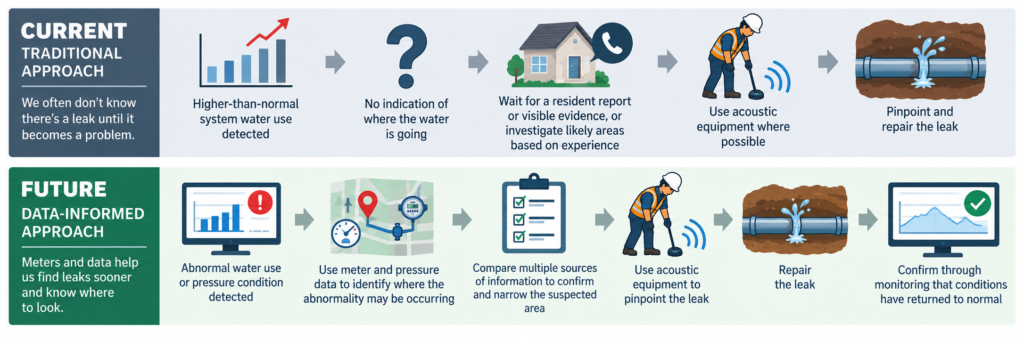
No single meter, pressure reading or resident complaint will automatically mean that there is a water-main leak. District operators will look at the overall picture.
Water entering the system, customer meter readings, pressure information, operating conditions, historical patterns and information from residents can all be compared. If those indicators point toward a possible distribution-system leak, staff can investigate the affected area with specialized leak-detection equipment.
This approach allows the District staff to make decisions based on several pieces of evidence rather than relying on a single reading.
A More Proactive Water System
The biggest change is that leak detection will become proactive rather than reactive.
Instead of waiting for water to appear at the surface or for a major pressure problem to develop, operators will have information that can help identify smaller changes in the system earlier.
As Clearwater collects more data, District operators will develop a better understanding of how the community’s water system normally behaves. That knowledge will make unusual water use and pressure changes easier to recognize.
The result will be better information, more targeted investigations and an improved ability to identify and respond to treated-water loss throughout Clearwater.